 Terug
Terug
Ensemble: SUPERDEMOCATIE / SUPERDEMOKRATIE / SUPERDEMOCRACY
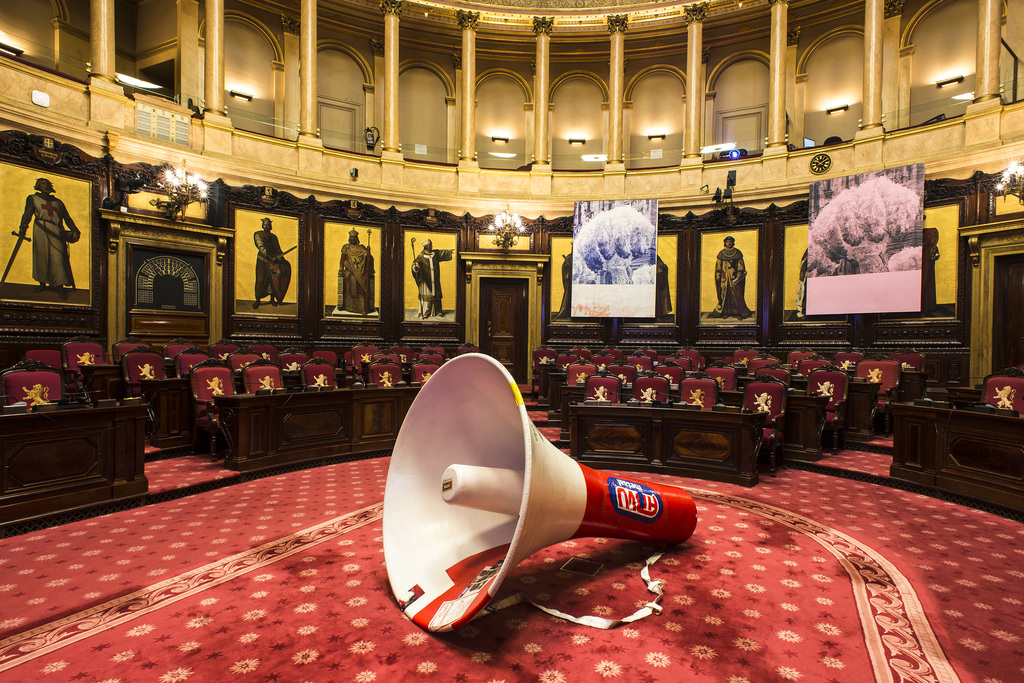
De stem van de burger weerklinkt luider dan ooit in de parlementen wereldwijd en de diversiteit van wie en ook van wat deze instellingen vertegenwoordigen, groeit zienderogen.
De sociale media zorgen vandaag voor een meer regelmatige wisselwerking tussen de burger en zijn vertegenwoordiger. Vele initiatieven brengen hen samen om via allerhande belangen- en actiegroepen te bouwen aan een breder draagvlak voor beslissingen. Interactie en dialoog vormen stilaan (terug) de spil van de besluitvorming. De representatieve democratie wordt alsmaar meer ook een ‘deliberatieve democratie’.
Bovendien zijn wie en wat het parlement representeert onderhevig aan grondige verandering. Het is immers niet enkel meer de vertegenwoordiger van een steeds diversere bevolking, maar ook van vele ‘niet-menselijke’ componenten van de wereld die eveneens zijn aandacht opeisen. Dierenrechten, monumentenzorg, technologische ontwikkeling, energie-ontginning en milieubescherming zijn actueler dan ooit. Het besef groeit dat, wil de mens overleven, hij de dieren en de ‘dingen’ niet meer enkel als een bezit kan beschouwen dat hem ten dienste staat, maar dat beide inherent deel uitmaken van de wereld, iets wezenlijks zeggen over de wereld en hun invloed doen gelden. Daarom spreken we hier, de socioloog Bruno Latour parafraserend, van ‘De Senaat der Dingen’.
Vertrekkend vanuit de vaststelling dat het functioneren van het politieke proces steeds complexer en beweeglijker wordt, lanceert deze tentoonstelling het begrip SUPERDEMOCRATIE. Net zoals herkomst niet meer volstaat om de groeiende verscheidenheid in de samenleving te duiden, valt de hedendaagse democratie niet langer te herleiden tot stemhokje en halfrond.
De tentoonstelling SUPERDEMOCRATIE geeft aan ‘samen-spraak’ het volle pond. De Belgische Senaat is daarvoor de uitgelezen plaats: als assemblee van de deelstaten is hij de plaats van reflectie en dialoog tussen de gemeenschappen over ‘transversale aangelegenheden’. En precies daarover gaan drie cultuurinstellingen - BPS22 in Charleroi, BOZAR in Brussel en M HKA in Antwerpen - de dialoog aan met het parlement.
Concreet focust de tentoonstelling op vijftien thema’s in evenveel zalen van de Senaat. Telkens worden kunstenaars van de Franse, de Vlaamse en een andere gemeenschap samengebracht. De combinaties van hun schilderijen, sculpturen, foto’s, video’s, installaties enz. uit de collecties van BPS22 en M HKA, tonen een mogelijke benadering van de thema’s. De toeschouwer wordt uitgenodigd verbanden te ontdekken met de door de Senaat behandelde materies en tussen de werken onderling en zo deel te nemen aan de dialoog waartoe ze uitnodigen.
Deze reflectie wordt gedurende de hele maand oktober voortgezet tijdens ‘discussiesalons’ en lezingen die de drie partners opzetten over de onderwerpen van de tentoonstelling.
Bart DE BAERE
Paul DUJARDIN
Pierre-Olivier ROLLIN
Thema's & Categorieën
DIVERSITAS IV

SOLIDARITEIT / SOLIDARITE / SOLIDARITY / SOLIDARITÄT

INVENTIO

RES PUBLICA

RADICALISERING / RADICALISATION / RADIKALISIERUNG

WELZIJN / BIEN ÊTRE / WELL-BEING / WOHLERGEHEN

REFLECTIE / REFLEXION / REFLECTION

ONDERZOEK / RECHERCHE / RESEARCH / FORSCHUNG

DIVERSITAS II

DIVERSITAS III

MOBILITEIT / MOBILITE / MOBILITY / MOBILITÄT

TEKSTVERZORGING / TOILETTAGE DES TEXTES / TEXT QUALITY / TEXTPFLEGE
ECONOMIE / ECONOMY / WIRTSCHAFT
DIVERSITAS I

CONCORDIA
Werken
![Chaise découpée [Cut-Up Chair]](https://s3.amazonaws.com/mhka_ensembles_production/assets/public/000/036/988/square_75/2017_SUPERDEMOCRATIE_Senaat_photo_M_HKA_6_38.jpg?1506686700)
Chaise découpée [Cut-Up Chair], 1964-2008
Jacques Lizène
Sculpture, wood, canvas, 83 x 40 x 35 cm
![!Vrouwenvragen? [!Women's questions?]](https://s3.amazonaws.com/mhka_ensembles_production/assets/public/000/036/990/square_75/2017_SUPERDEMOCRATIE_Senaat_photo_M_HKA_6_40.jpg?1506687080)
!Vrouwenvragen? [!Women's questions?], 1965
Jef Geys
Installation, ink, paper, 600 x 140 cm
![Water te Water [Water to Water]](https://s3.amazonaws.com/mhka_ensembles_production/assets/public/000/000/624/square_75/Mees,%20Guy,%20Water%20te%20water,%201970%20scan.jpg?1302191148)
Water te Water [Water to Water], 1970
Guy Mees
Video, dvd, 00:03:13

Les Animeaux de la ferme, 1974
Marcel Broodthaers
Print, ink, paper, 81.9 x 60.3 cm
![Zonder titel (Broodkruis) [Untitled (Bread Cross)]](https://s3.amazonaws.com/mhka_ensembles_production/assets/public/000/000/030/square_75/Heyvaert,%20Ren%C3%A9,%20Untitled,%201988%20photo%20clinckx.jpg?1296656974)
Zonder titel (Broodkruis) [Untitled (Bread Cross)], 1981
René Heyvaert
Sculpture, bread, wood, 118 x 118 x 4 cm

Anima Mundi (Bangkok), 1983
Marina Abramović & Ulay
Photography, 2 x (180 x 120 cm)

Immortality Is Just a State of Mind, 1987
Jean-François Octave
Other, 2 x (100 x 100 cm)

Peinture Cérébrale, 1989
Jacques Charlier
Sculpture

Sans titre (mains chaudes), 1990-1994
Michel François
Photography, 225 x 160 cm

In 80 dagen rond de wereld - around the world in 80 days Weber - Madrid - Weber, 1993
Luc Deleu
Installation, mixed media, 193 x 102 cm

Impatiente, 1995
Tapta
Installation, steel and rubber on wheels, variable dimensions

Calais, 1995-2004
Marthe Wéry
Installation
![Nursing Activities, Direct (Verpulveren) [Nursing Activities, Direct (Pulverizing)]](https://s3.amazonaws.com/mhka_ensembles_production/assets/public/000/088/078/square_75/2022_Museum_In_Motion_AMVK_photo_M_HKA_clinckx_TEN_F_4.jpg?1665755613)
Nursing Activities, Direct (Verpulveren) [Nursing Activities, Direct (Pulverizing)], 1995-1998
Anne-Mie Van Kerckhoven / AMVK
Installation, videoband vhs, hout, metaal, 190,5 x 529 x 75 cm (geheel), 2 x 1 m (platen)

Les Quatre Saisons de Moniteur belge, 1996
Denmark
Sculpture, 4 x (147 cm x 24 cm x 16 cm)

Worthlessness, 1997
Edith Dekyndt
Video

Djellabas Nike, Fila, Adidas, 1998
François Curlet
Installation

EU Vlag, 1999
Christophe Terlinden
Object, 92 x 150 cm

I Will Die, 2000
Yang Zhenzhong
Video, 00:11:36

Série Syrie, 2001
Willi Filz
Photography

Maison Belge Supermarché de l'année, 2001
Angel Vergara
Painting, ink, canvas, crayon, acrylic, collage, 280 x 500 cm

Ode, 2001
Victor Alimpiev & Marian Zhunin
Video, dvd, 00:34:30 min

Global Empowerment, 2002
Sven 't Jolle
Sculpture, 141 x 143 x 210 cm

Birth of a Nation, 2003
Michael Van den Abeele
Multiple, textile, 140 x 210 cm

1 hour 30 minutes sculpture, 2003
Vaast Colson
Print, lambda print, 86.5 x 88.6 x 5 cm

L’Africeur de Bogolan, 2004
Narcisse Tordoir, Bréhima Kone
Installation, bogolan, silkscreen, acrylic, variable dimensions

Inch'Allah, 2005
Ria Pacquée
Video, videotape digital betacam, dvd, 00:18:40

Change, 2005
Koka Ramishvili
Video, dvd, 00:04:20 min

Atlas, 2006
Johan Muyle
Installation, 135 cm x 110cm x 90cm ; 220 cm x 116 cm x 105 cm ; 135 cm x 113 cm x 78 cm

Ohne titel (Who's got the big picture), 2006
Johanna Kandl
Painting, tempera, canvas, 258 x 354 cm

Screen, 2006
Carla Arocha
Installation, plexi, stainless steel, 216.4 x 350 x 150 cm
![Zonder titel [Untitled]](https://s3.amazonaws.com/mhka_ensembles_production/assets/public/000/008/541/square_75/Tayou__Pascal__Vlag__Europees-Zuid_Africaans__2007_photo_clinckx1.JPG?1334222156)
Zonder titel [Untitled], 2007
Pascale Marthine Tayou
Object, textile, 92.5 x 146 cm

Ladyboy - Curleyman I, 2007
Jan Van Imschoot
Painting, 190 x 170 x 3 cm

Corporate Armies, 2008
PSJM
Video

Usine occupée. 46 portraits de travailleurs de Royal Boch, 2009
Véronique Vercheval
Photography

Ane(c)dote, 2009
Mira Sanders
Print, ink, paper

Down Under, 2009
Sheela Gowda
Sculpture, textile, 184 x 125 x 8 cm

Nach Diane Arbus, 2012
Miriam Cahn
Other, 180 x 110 cm

Le petit chevalet montrant le constat complété et le flacon, 2012
ORLAN
Object

Biblimlen, 2013
Sasha Pirogova
Video, hd video, sound, 00:10:00

United Colors, 2014
Thierry Verbeke
Other, textile, 225 x 150 cm

Mutus Liber 953, 2014
Kendell Geers
Sculpture

Tracing Cheikh Anta Diop , 2014
Vanessa Van Obberghen
Photography, digital print on aluminium foil mounted on dibond, 150 x 100 cm

Drapeau, 2015
Emilio López-Menchero
Mixed Media

La Méduse / l'Autruche, 2015
Marcel Berlanger
Print, 2 x (280 x 220 cm)

Tightrope, 2015
Taus Makhacheva
Video, 4k video, colour, sound, 73 min

Réfractaires, 2016
Charlotte Beaudry
Installation, 345 x 302 cm

There Are Snakes Everywhere…, 2017
Liliane Vertessen
Mixed Media, textile

Klok, 2017
Suchan Kinoshita
Object, glas, shampoo