 Back
Back
Ensemble: New Space Travel Basics
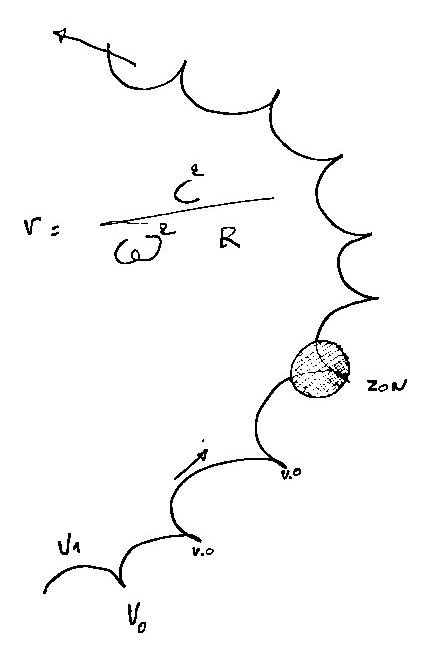
“Art precedes science” - Panamarenko
With his theory of closed systems, as from 1968 Panamarenko tried to prove the possibility of launching a mass out into space, with the energy needed for its forward movement contained in a closed system. He clarified his theory by means of a coin that he flipped away with his thumb. Panamarenko did a drawing of the trajectory of the coin, which resulted in a geometrical figure with various speeds. By replacing the coin by an electron whose mass, circumference and speed are known, he subsequently arrives at a standard formula to calculate the revolution and changes of speed of the planets and stars. However, the drawings and calculations encountered considerable opposition from established scientists. By involving the fourth dimension in his theory, Panamarenko gained a new galactic insight, which in the early 1990s resulted in a theory of space which he called his Toymodel of Space. He explained the theory in a short film in 1993, in which he outlines his view of how the universe works.
Works

Monopool experiment (Liquid Helium), 1979
Panamarenko
Drawing, pencil, felt-tipped pen, tape, paper, 22.5 x 29 cm

Witte meeuwen, 1979
Panamarenko
Drawing, pencil, pen, paint, colour pencil, tipp-ex, paper, 33 x 21 cm
![Grote Plumbiet [Big Plumbite]](https://s3.amazonaws.com/mhka_ensembles_production/assets/public/000/018/901/square_75/P116.jpg?1378116136)
Grote Plumbiet [Big Plumbite], 1984
Panamarenko
Drawing, felt-tipped pen, tape, tracing-paper, 10 x 15 cm

Toymodel of space, 1990-1999
Panamarenko
Miscellaneum, sketchbook, 29,5 x 21 cm

Viaggio alle stelle, 1996
Panamarenko
Multiple, bl&w print, montage depicting adamski saucer, 44 x 76 cm

Bing II, 2003
Panamarenko
Drawing, pencil, colour-pencil, paper, 29 x 42 cm

Kleine Plumbiet Neodure
Panamarenko
Drawing, pencil, paint, colourpencil, pen, paper, 29.5 x 41 cm