Tekenen / Drawing / Dessins / Zeichnen
Ensemble
To make his works on paper, Joseph Beuys used different materials, from more traditional ones such as pencil, pastel, oil and collage, to rather unconventional ones such as hare’s blood, beeswax, chalk and chocolate. In his drawings, many of Beuys' inspirations appear: mythology, Christian tradition, nature, literature, alchemy and anthropology. Common themes include animals, the shaman, revolution, social structures and the landscape. Often Beuys would use a colour he described as 'Braunkreuz', a matt brown oil paint used for painting floors. Over time, Beuys started to use more words and emblems in his drawings. Beuys' contacts with the Fluxus movement also had an influence on his drawings, taking on the form of a new genre: as being themselves the result of actions, but also as the score for a future action.
'My drawings make a kind of reservoir that I can get important impulses from. In other words they’re a kind of basic source material that I can draw from again and again.'
From: Heiner Bastian and Jeannot Simmen, Interview with Joseph Beuys in the catalogue of the exhibition Zeichnungen/Tekeningen/Drawings, Museum Boymans-van Beuningen, Rotterdam, Nationalgalerie Berlin, Kunsthalle Bielefeld, Wissenschaftszentrum Bonn (1979-1980), Rotterdam, 1970-80, p. 93-94.

Items
View all-

Demonstration für Lohaus
Joseph Beuys, Demonstration für Lohaus, 1962. Collage, pencil, oil colour, water colour, gold colour on paper, adhesive edges, paper, 22 x 15.4 cm.
-

Zelt und Lichstrahl
Joseph Beuys, Zelt und Lichstrahl, 1980. Print, aquatint lithography;ink on paper, 20.5 x 14.5 cm / 32 x 24.5 cm.
-
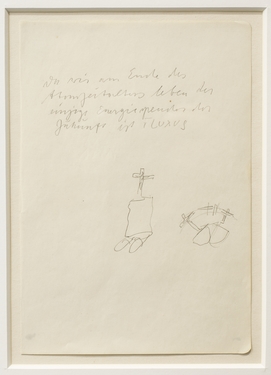
Untitled
Joseph Beuys, Untitled. Drawing, pencil, paper, 20.9 x 14.5 cm.
-

Schädel auf Urschlitten
Joseph Beuys, Schädel auf Urschlitten, 1954. Drawing, pencil, watercolour, cardboard, 26 x 39.5 cm.
Actors
View all