Hugo Roelandt — BODY & SELF PORTRAITS
Ensemble
“At the time I made photographs, but I refused to photograph what was in front of me, what is out there. What interested me was to change in a very conscious way certain situations and to record this. Photography was a suitable medium for that. In the long run changing things became more important than photography itself and thus it is a small step to turn to ‘live’ events. (…) Anyway, I didn’t myself call these first ‘appearances’ performances. It is only because the medium got known here that the name, which was common at the time, was given to the things I was doing.”
– Interview with Hugo Roelandt by Luc Mishalle, in CET-Bulletin, 1980, nr.5, p. 4-6.
BODY
The body was the recurrent source of questions in Hugo Roelandt’s works, particularly in performances, from the interaction with the camera lens to the redundancy of the artist in his ‘post performance’ pieces. With a practice oriented towards society, the question of body image was crucial for Roelandt. His key installation and action, Research About the Actual Aesthetic Ideal (1976), offered the opportunity for the audience to think about the aesthetic ideals of the human form from their personal perspective, and also to think about the sexualised gaze in media and society. In Roelandt’s view, the focus on the body was a way to be political.
SELF PORTRAITS
Throughout his career, Hugo Roelandt created several series of photographic self-portraits, often manipulating them with marker pen or paint. Rather than being representations of himself, these self-portraits could be seen as the artist taking on alternative personalities. Projected Feelings Toward Something or Somebody (1974), for example, a series in which he photographed his own face expressing various emotions in an exaggerated manner, demonstrates how Roelandt was interested in “changing a reality in front of a camera” rather than in traditional narrative art photography. This idea aligns with a broader investigation by artists and theorists in the 1970s around how live performances, staged for photo or film, challenged notions of presence and representation.
In the 1990s, Roelandt returned to several earlier self-portraits from the 1970s and edited them. He also made new self-portraits with a monitor, and printed early digital photographs in red, green and blue using a dot matrix printer. These experiments in self-portraiture foreshadowed the way Hugo Roelandt would continue to reinvent himself beyond the conventions of classical artistic media.

Items
View all-
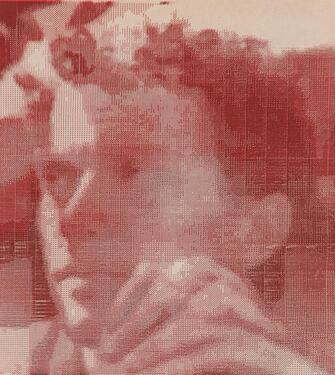
Digitaal zelfportret Red ...
Hugo Roelandt, Digitaal zelfportret Red Green Blue / Digital Self-Portrait Red Green Blue. Series.
-
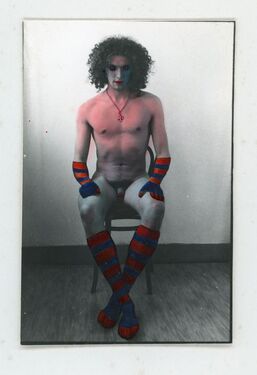
Zelfportret / Self-portrait
Hugo Roelandt, Zelfportret / Self-portrait, 1970. Photography, manipulated photo on paper.
-
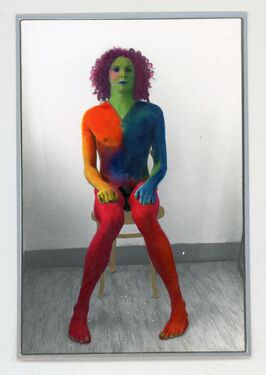
Zelfportret / Self-portrait
Hugo Roelandt, Zelfportret / Self-portrait, 1970. Photography, manipulated photo on paper.
-

Zelfportret / Self-portrait
Hugo Roelandt, Zelfportret / Self-portrait, 1970. Photography, manipulated photo on paper.
Actors
View all