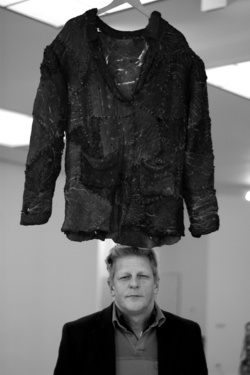
Gangsters en metamorfose [Gangsters and Metamorphosis]
Ensemble
As a young streetfighter Jan Fabre starts to recognize the beauty of the language of the street. The sense of loyalty that reigns there is very important to him. The poetry and the style of streetfighting, the law of the street based on physical and mental strength, along with its code of honour, comprise an important stimulus for his performances. To gather material, the young artist broke into villas in the richer suburbs of Antwerp. He and his friends constituted the 'Cartouche' gang. Objects they stole were sold for art materials or subsequently used in installations. Bounty from these raids were presented by Fabre in Burglaries & Street-Fights. In Het gevecht [The fight] he depicts the law of the street in a short fragment.
In the Louvre, Fabre offers a 5 hour-long performance of Art kept me out of jail, inspired by the French gangster Jacques Mesrine, a figure who had long fascinated the artist. Between ancient sculptures and sarcophagi, Fabre appears in always-different (dis)guises, to finally fall to a long salvo of gunfire. In Fabre's eyes, Mesrine is an escape artist and a master of metamorphosis. The figure of Mesrine is a metaphor for the artist as a louse in the fur coat of society. At the same time, the performance is a commentary on the status and role of the museum: art is not only be preserved; it must also again find its way into the wider world to acquire true meaning.
Metamorphosis and transfiguration have been important motifs in Jan Fabre's performances from the very start. At the end of the 1970s, the artist has his then girlfriend - a makeup artist - regularly transform him into a wide variety of characters: Fred Astaire, Jim Morisson, Jacques Mesrine, an Arabian prince, etc. The precision of Fred Astaire inspires him to look at choreography like drawing with the body. The performance Tonight I want to be Fred Astaire. Tonight I want to be a killer, is a metamorphosis from animal to human and from human to animal. By way of reaction to his own lean aspect as a young lad, in Ich bin ein Skelettmann Fabre lets himself be fitted out for a suit of flesh. Subsequently, for the film by Pierre Coulibeuf, this 'Skeleton Man' again appears, this time in dialogue with the 'meaty' works of Peter Paul Rubens.

Items
View all-
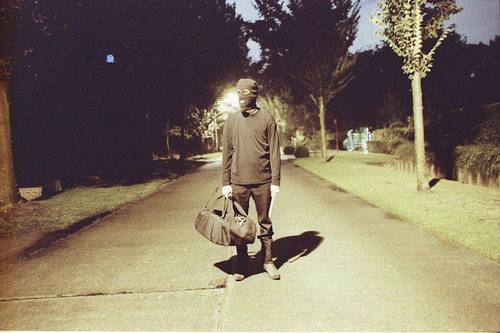
Burglaries & Street Fights
Jan Fabre, Burglaries & Street Fights, 1978. Performance, various duration.
-
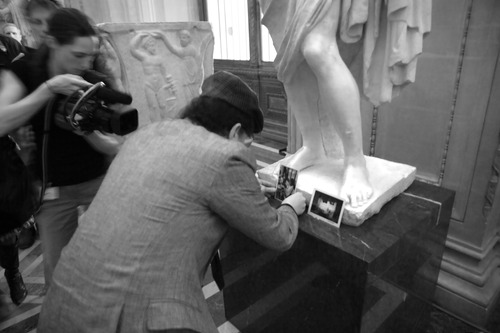
Art kept me out of jail (...
Jan Fabre, Art kept me out of jail (Homage to Jacques Mesrine), 2008. Performance, 04:00:00.
-

Television action: The Em...
Jan Fabre, Television action: The Emperor's New Clothes, 1984. Performance, 00:10:00.
Actors
View all